
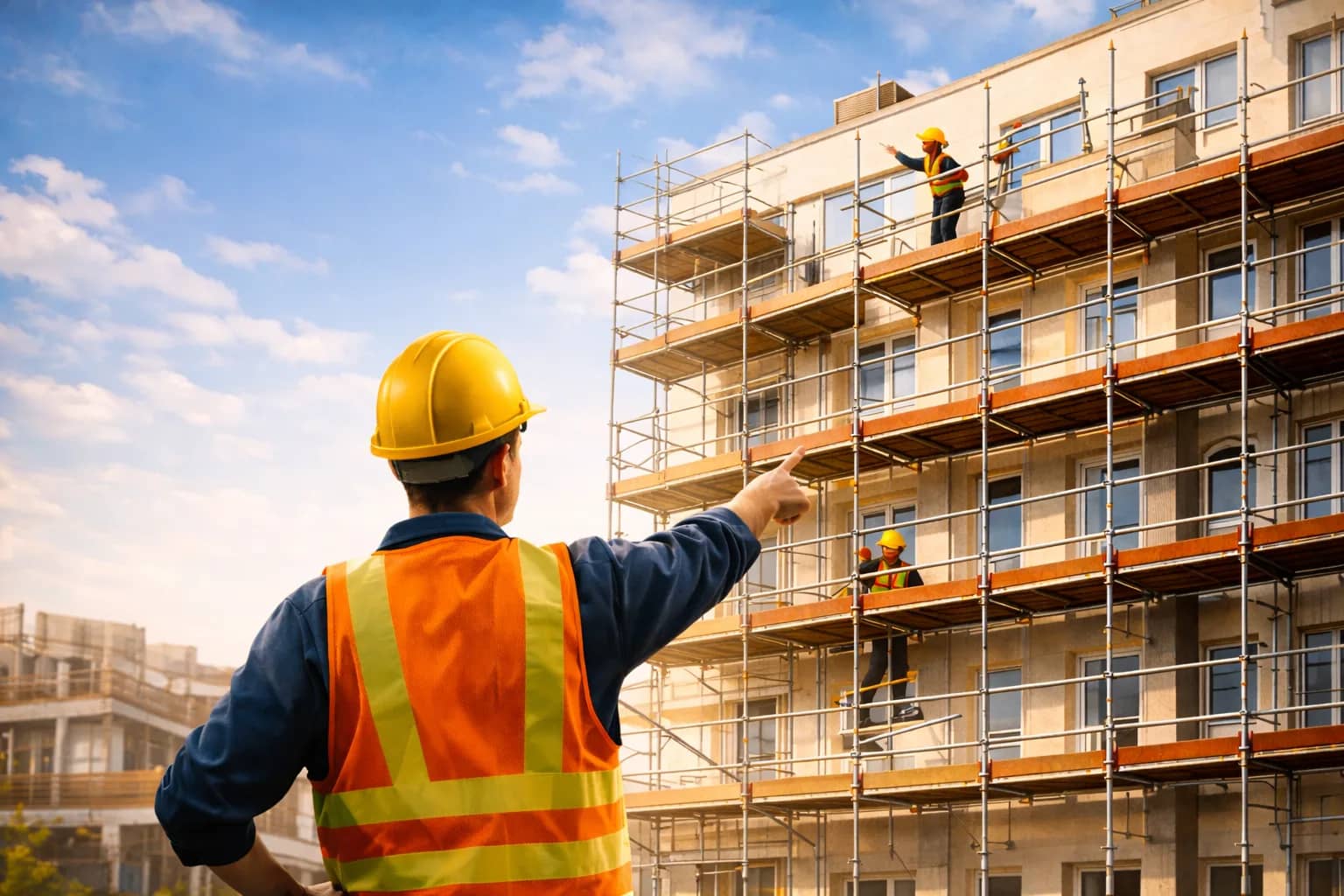
How to Choose Scaffolding for Facade Works?
Why is choosing scaffolding important?
Improperly selected scaffolding is not only a waste of money – it is primarily a risk to the safety of the construction crew. Too narrow walkways, insufficient load capacity, or lack of stability on uneven terrain can lead to accidents. On the other hand, oversizing the set means unnecessary rental and transportation costs.
Choosing scaffolding for the façade requires consideration of several key parameters. Below we discuss each of them step by step.
Step 1: Determine the dimensions of the façade
Before you start looking for scaffolding, measure (or estimate) the basic dimensions:
- Length of the façade – how many linear meters of wall need to be covered by scaffolding.
- Height of the building – from ground level to the highest point you need access to (parapet, cornice, roof overhang).
- Shape of the building – is the façade flat, or does it have recesses, bay windows, balconies, or loggias?
These data allow calculating the surface area of the scaffolding in square meters and selecting the appropriate number of elements.
Step 2: Choose the type of system
PIN-74 frame scaffolding
The most popular choice for standard façade works. Advantages:
- Low rental cost
- Quick assembly (PIN connecting system)
- Proven solution, available from most suppliers
- Ideal for buildings up to 35 m height
When to choose: single-family houses, buildings up to 10 stories, painting works, thermal insulation, plastering.
UNICO-73 frame scaffolding
A more modern system with a higher load capacity (300 kg/m²). Advantages:
- Greater stability of the structure
- Integrated safety systems
- Ability to build platforms at different levels
When to choose: buildings requiring a higher load capacity of the walkways, works with heavy equipment on the scaffolding.
Modular scaffolding
The most flexible system, allowing for any configuration. Advantages:
- Adaptation to any shape of the building
- Load capacity up to 600 kg/m²
- Ability to create passages, stairs, platforms
When to choose: complex facades, industrial facilities, buildings with irregular shapes, high structures (up to 50 m).
Warsaw (tube) scaffolding
A classic solution based on tubes and fittings. Advantages:
- Lowest cost
- Flexible adaptation to the shape of the building
- Does not require specialized equipment
When to choose: minor renovation works, tenement renovations, short-term painting works.
Step 3: Consider conditions on the construction site
Ground
Scaffolding must stand on stable, even ground. If the area is uneven, sloped, or swampy, you need:
- Leveling pads
- Adjustable bases (jacks)
- Possibly foundation platforms
Access
Check if there is space on the construction site for:
- Unloading transport (truck, crane truck)
- Storing elements before assembly
- Unobstructed access for the assembly crew
Obstacles
Balconies, loggias, downpipes, installations on the façade – all of these affect the scaffolding configuration. An experienced supplier will take these elements into account in the design.
Step 4: Plan for safety
Every scaffolding must meet safety standards (EN 12810, EN 12811). Key elements:
- Protective railings – at every working level
- Curbs (edge boards) – protection against falling materials
- Access ladders – safe access to platforms
- Anchoring to the wall – stabilization of the structure, especially important in windy conditions
Do not save on safety elements. This is not a place to cut costs.
Step 5: Consult with the supplier
Even if you have experience in construction, it is worth consulting the choice of scaffolding with the supplier. A professional company:
- Will help you choose the optimal system for your project
- Will prepare a detailed list of elements
- Will consider conditions on the construction site (ground, obstacles, access)
- Will propose a solution that does not incur unnecessary costs
Common mistakes in selection
- Underestimating height – always add a margin (minimum 2 m above the highest working point).
- Ignoring corners – scaffolding must cover the corners of the building, which requires additional elements.
- Lack of planning for dismantling – plan how and when the scaffolding will be dismantled before you order it.
- Ignoring wind – in open areas and at great heights, wind is a real threat. Anchoring must be appropriate.
Summary
Choosing scaffolding for the façade is a process that requires considering the dimensions of the building, the type of system, conditions on the construction site, and safety requirements. There is no one-size-fits-all solution – each investment is different.
Want to quickly check which set will be optimal for your project? Use our calculator – in a few steps you will select the system, dimensions, and receive an approximate quote.
👉 Launch the calculator and choose scaffolding for your façade.
Need a quote?
Use our calculator – in 2 minutes you'll get an estimated price, element list and a visual configuration drawing.
👉 Launch calculator