
Ceiling Formwork Rental - Price
How much does it cost to rent floor formwork?
Floor formwork is an essential element in the construction of any building with a monolithic concrete ceiling. Most construction companies and individual investors opt for rental instead of purchase – and rightly so. Why? Because purchasing a full set of formwork is an investment amounting to tens, or sometimes even hundreds of thousands of złoty. The equipment that will take up space in storage after the project is completed generates storage and maintenance costs.
Renting provides flexibility – you only pay for the actual usage time, you receive exactly as many elements as you need, and the supplier takes care of maintenance and storage. But how much does it actually cost? Below, we break down the rental price of floor formwork into its components.
What affects the price of renting floor formwork?
1. Ceiling area
This is the most important parameter. The larger the ceiling, the more components you need:
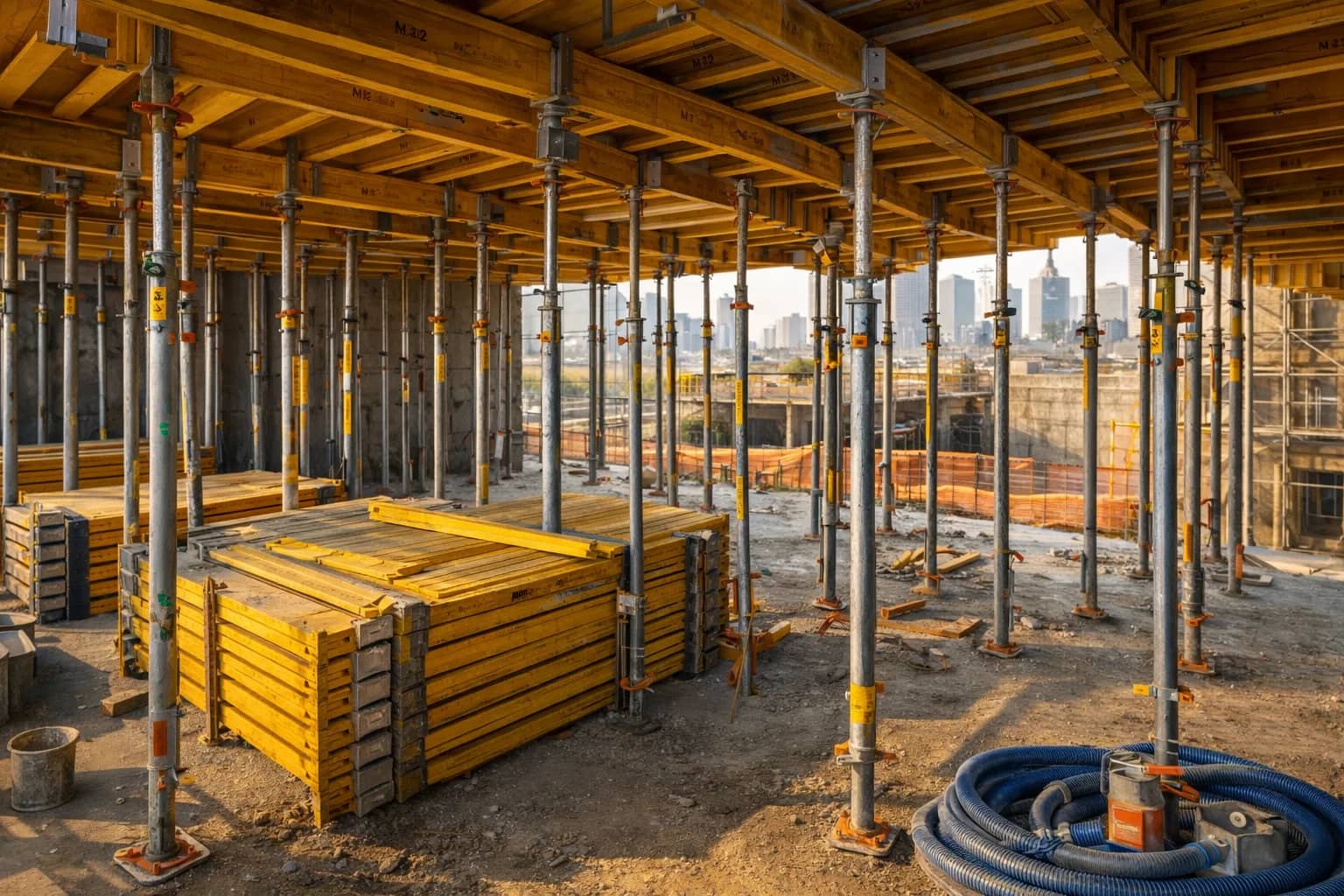
- Telescopic props (the number depends on the spacing, usually 1 prop per 1.5–2 m²)
- Formwork beams H20 (main and distribution)
- Formwork plywood (matching the ceiling area + extra for cutouts)
- Heads and supports
Typical ceiling area in construction:
- Single-family house: 80–150 m²
- Multi-family building (1 floor): 200–600 m²
- Commercial/industrial facility: 1000+ m²
2. Ceiling thickness
Ceiling thickness affects the load and required load capacity of the formwork:
- Ceiling 15–18 cm (typical in single-family homes) – standard props and spacing
- Ceiling 20–25 cm (blocks, office buildings) – denser prop spacing
- Ceiling 30+ cm (halls, warehouses, industrial structures) – reinforced props, denser spacing
The thicker the ceiling, the greater the concrete load per m², and consequently – more props and stronger beams.
3. Floor height
The height from the floor to the bottom of the ceiling determines the length of the props:
- 2.5–3,5 m – standard telescopic props (2.0–3,5 m or 1.8–3,0 m)
- 3.5–5,5 m – longer telescopic props or prop towers
- 5.5+ m – aluminum or steel prop towers
Higher floors = more expensive props and more difficult assembly.
4. Duration of rental
Rental of floor formwork is settled monthly or weekly (depending on the supplier). Typical rental period:
- 4–6 weeks – concrete curing time + assembly and disassembly
- 2–3 months – for larger facilities or slower work pace
Most suppliers offer:
- First month – full rate
- Subsequent months – reduced rate (often 50–70% of the first month)
5. Type of formwork system
Various systems are available on the market:
Frame formwork (traditional)
- Beams H20 + telescopic props + plywood
- Most versatile
- Average rental price
Table formwork
- Ready panels assembled as a whole
- Faster assembly and disassembly
- Higher rental cost, but savings on labor
Tunnel systems
- For repetitive ceilings (development)
- Most expensive to rent, profitable with many identical floors
Indicative prices for renting floor formwork
The rates below are market approximations for 2026. The actual price depends on the region, supplier, and scale of the project.
Rental per m² of ceiling area
The most popular billing model:
| Type of formwork | Price per m²/month |
|---|---|
| Frame formwork (beams H20 + props) | 15–25 zł/m² |
| Table formwork | 25–40 zł/m² |
| Tunnel systems | 35–60 zł/m² |
Rental of telescopic props (per piece)
If the supplier bills components separately:
| Type of prop | Price per piece/month |
|---|---|
| Prop 2.0–3,5 m (standard) | 8–15 zł |
| Prop 1.5–2,7 m (short) | 6–12 zł |
| Prop 3.0–5,0 m (long) | 12–20 zł |
| Prop tower (up to 8 m) | 80–150 zł |
Formwork beams H20 (per running meter)
| Element | Price per linear meter/month |
|---|---|
| Beam H20 (various lengths) | 2–4 zł/mb |
Formwork plywood (per m²)
| Type of plywood | Price per m²/month |
|---|---|
| Plywood 21 mm (film-faced) | 4–8 zł/m² |
| Plywood 27 mm (reinforced) | 6–10 zł/m² |
Example estimate – single-family house
Parameters:
- Ceiling area: 100 m²
- Ceiling thickness: 20 cm
- Floor height: 2,8 m
- Rental time: 1.5 months (6 weeks)
Calculation (billing per m²):
- Rental of frame formwork: 100 m² × 20 zł/m²/month = 2,000 zł/month
- Rental time: 1.5 months = 3,000 zł
Calculation (billing per elements):
- Props: 60 szt × 10 zł/piece/month × 1.5 = 900 zł
- Beams H20: 250 mb × 3 zł/mb/month × 1.5 = 1,125 zł
- Plywood: 105 m² × 6 zł/m²/month × 1.5 = 945 zł
- Heads + supports: 60 szt × 2 zł/piece/month × 1.5 = 180 zł
- Total cost of elements: 3,150 zł
Additional costs:
- Transport (delivery + collection): 800–1,500 zł
- Assembly + disassembly: 100 m² × 15 zł/m² = 1,500 zł (optional)
Total rental cost (excluding assembly): 3,800–4,650 zł
Total cost "turnkey": 6,100–7,650 PLN
Sample valuation – multi-family building
Parameters:
- Ceiling area: 400 m²
- Ceiling thickness: 22 cm
- Floor height: 3,0 m
- Rental period: 2 months
Calculation (settlement per m²):
- Rental of frame formwork: 400 m² × 18 PLN/m²/month = 7,200 PLN/month
- First month: 7,200 PLN
- Second month (50% rate): 3,600 PLN
- Total rental: 10,800 PLN
Additional costs:
- Transport: 1,500–2,500 PLN
- Assembly + disassembly: 400 m² × 12 PLN/m² = 4,800 PLN
Total cost "turnkey": 17,100–18,100 PLN
Transport of formwork – what to know?
Transport costs depend on:
- Distance from the supplier's warehouse – the farther, the more expensive
- Amount of equipment – large projects require several transports
- Construction site accessibility – can the TIR/HDS approach directly?
Estimated transport costs:
- Up to 50 km: 600–1,200 PLN
- 50–100 km: 1,000–2,000 PLN
- 100–200 km: 1,500–3,000 PLN
- Over 200 km: 2,500–5,000 PLN
For large orders (above a certain rental amount), suppliers often offer free transport or transport at a reduced price.
Installation and disassembly – how much does it cost?
If you do not have your own assembly team, the supplier can provide assembly and disassembly. The price depends on:
- Ceiling area
- Floor height
- Complexity of the structure (openings, passages, balconies)
Estimated assembly rates:
- Assembly: 10–20 PLN/m² of ceiling area
- Disassembly: 8–15 PLN/m² of ceiling area
- Total: 18–35 PLN/m²
For a ceiling of 100 m², the cost of assembly and disassembly is 1,800–3,500 PLN.
How to save on ceiling formwork rental?
1. Clearly define the scope
The more precise the dimensions and parameters, the more accurate the valuation. Avoid overpaying for excess elements or incurring costly orders for missing items.
2. Plan the schedule
Concrete needs time to harden (usually 28 days to reach full strength, but formwork removal is possible after 14–21 days under appropriate conditions). Plan your work to minimize rental time without risking premature formwork removal.
3. Choose a comprehensive package
Rental + transport + assembly + disassembly in one package is often cheaper than ordering services separately.
4. Negotiate for larger projects
If you have several floors or buildings, negotiate the rate – suppliers are often willing to lower the price for large orders.
5. Choose a local supplier
The closer to the supplier's warehouse, the lower the transport cost and faster response in case additional elements need to be delivered.
6. Consider self-assembly
If you have an experienced team, you can save several thousand PLN by assembling the formwork yourself. But be careful – improper assembly poses serious safety risks.
Comparison: rental vs purchase
| Criterion | Rental | Purchase |
|---|---|---|
| Initial cost | Low (a few thousand) | High (tens of thousands – hundreds of thousands) |
| Flexibility | Full (customizable for each project) | Limited (you have what you bought) |
| Maintenance | Supplier | You |
| Storage | Supplier | You (cost of storage space) |
| Cost-effectiveness | One-time or occasional projects | Continuous operation with multiple projects |
Conclusion: For most construction companies and investors, rental is more cost-effective.
Most common mistakes in formwork rental
1. Underestimating rental time
You assume concrete will be ready for formwork removal after 2 weeks, but weather conditions (low temperature, high humidity) extend hardening time. The effect? You have to extend the rental, often at a higher rate.
2. Lack of spare elements
You order formwork "just in time" – exactly as shown in the calculation. The problem arises when you find you need a few additional beams or props. Always add 5–10% spare.
3. Ignoring return conditions
Check the condition in which you must return the equipment. Does the plywood need to be cleaned? Will damaged elements incur charges? The cost of damages or dirty plywood can be high.
4. Lack of insurance
Who is responsible for the destruction or theft of formwork from the construction site? Ensure that your construction insurance covers rented equipment.
Summary
The price of ceiling formwork rental primarily depends on:
- Ceiling area (main parameter)
- Ceiling thickness (affects the number of props)
- Floor height (type of props)
- Rental time (months)
- System type (frame, table, tunnel)
For a typical single-family house (ceiling 100 m²), the total rental cost with transport is 3,800–4,650 PLN. Adding assembly and disassembly raises the cost to 6,100–7,650 PLN.
For larger facilities (blocks, office buildings), costs can reach tens of thousands, but unit rates per m² are usually lower due to economies of scale.
The best way to know the exact price? Prepare the parameters of the ceiling (area, thickness, height) and contact 2–3 suppliers for a quote. You can also use an online calculator that will show estimated costs in a few minutes.
👉 Run the calculator and check the cost of ceiling formwork rental.
Need a quote?
Use our calculator – in 2 minutes you'll get an estimated price, element list and a visual configuration drawing.
👉 Launch calculator